
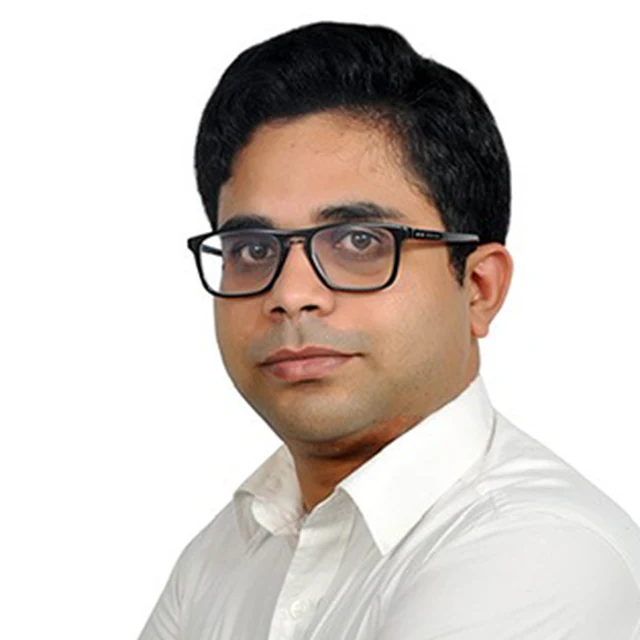
Arindam Mandal
Runs the strategy that took Marcellus outside India — 20 to 30 global companies put through the same forensic accounting framework the firm built for Indian equities. He is one of very few Indian PMS managers whose formative decade was spent investing from the United States rather than from Mumbai.
Is Arindam worth your time?
A global-platform investor running an Indian house's first international book. Mandal spent close to ten years at Principal Global Investors in the US, moving from quantitative research into fundamental analysis as lead analyst on US and global industrials and utilities, and from early 2019 overseeing India public equity across PGI's global platform. He joined Marcellus in 2022 to build and run the Global Compounders Portfolio, a concentrated global mandate. A point to weigh: his record as a named PMS manager starts in 2022 and is short, and a cross-border mandate brings currency, tax and regulatory-route considerations a domestic portfolio simply does not have.
Investors who already hold a domestic equity core and want a deliberate, concentrated slice of global businesses with no comparable listed equivalent in India — diversification away from a single-country economic cycle. It suits people willing to deal with the operational side of a cross-border mandate: custody, currency conversion, remittance under the applicable regulatory route, and a different tax treatment. Best read as a satellite allocation with a long horizon, not as a first PMS.
- His record as a named PMS portfolio manager begins in 2022 and is short — the decade before was analyst roles.
- Returns to an Indian investor move with the rupee against the currencies the underlying holdings are denominated in.
- Regulatory limits on overseas investment can constrain deployment — ask which route the strategy uses and whether it is open.
- Global Compounders is smaller than Marcellus' flagship Indian mandates and was built around a single hire — ask about bench depth.
About Arindam Mandal
Arindam Mandal is the portfolio manager of the Global Compounders Portfolio at Marcellus Investment Managers, the SEBI-registered portfolio manager founded in Mumbai in 2018. He joined Marcellus in 2022 to build and run the firm's global equity capability, the mandate that took its research framework outside the Indian listed universe.
He holds a B.Tech from NIT Warangal and an MBA in Finance from Duke University's Fuqua School of Business. He began his career as a lead software engineer at Oracle Corporation, then spent close to ten years in the United States with Principal Global Investors — joining as a quantitative analyst, moving into fundamental research as lead analyst on US and global industrials and utilities, and from early 2019 overseeing India public equity investments across PGI's global equity platform.
Career
- 2022 – present
Portfolio Manager, Global Compounders Portfolio, Marcellus Investment Managers
Joined to build and lead the firm's global equities effort. Runs a concentrated portfolio of 20 to 30 companies drawn from developed and emerging markets, selected on the firm's forensic research framework.
- from early 2019
Emerging markets and India public equity oversight, Principal Global Investors (United States)
Broadened his mandate to include emerging markets and oversaw India public equity investments across PGI's global equity platform — assessing Indian businesses against global comparables before joining an Indian manager.
- earlier
Lead Analyst, US and Global Industrials and Utilities, Principal Global Investors
Fundamental equity research in capital-intensive, cyclical sectors where capital allocation discipline separates good businesses from bad ones over a full cycle.
- earlier
Quantitative Analyst, Principal Global Investors
Systematic research — his entry point at PGI, where he spent roughly a decade in total.
- before PGI
Lead Software Engineer, Oracle Corporation
Product research and development. An unusual start for a fund manager, and the grounding for the quantitative work that followed.
Five principles
Moats, assessed globally
The core question is unchanged from the firm's Indian work — can this business defend high returns on capital for a decade or more? — but the competitive analysis is harder, because a moat that looks impregnable in one market may be under attack from a competitor in another.
Capital allocation as the differentiator
A direct inheritance from his research background in industrials and utilities, where management's decisions about where to deploy cash determine long-run returns more than operational execution does.
Forensic accounting, adapted across regimes
Applying accounting-quality screens across jurisdictions means working with different standards, disclosure norms and audit cultures. The firm treats this as a large part of the work rather than a formality.
Concentration, by global standards
At 20 to 30 holdings the portfolio is diversified by Marcellus' standards and concentrated by the standards of a global fund. Individual holdings matter to the outcome.
A genuinely global opportunity set
Developed and emerging markets rather than a single geography — the stated upside being diversification away from one country's economic cycle, and access to business models with no comparable listed equivalent in India.
The call that shows the method working
Taking the Marcellus framework outside India
Marcellus was founded in Mumbai in 2018 and built its shelf on forensic research over the Indian listed universe — Consistent Compounders, Little Champs, Rising Giants, Kings of Capital, MeritorQ. In 2022 the firm brought Mandal in specifically to build a global equity capability, and the Global Compounders Portfolio is the result: the same insistence on accounting quality and durable returns on capital, run over developed and emerging markets rather than one country. It is the strategy that took the firm outside India.
He was an unusually direct fit for the job. From early 2019, in his last stretch at Principal Global Investors in the United States, he oversaw India public equity investments across PGI's global equity platform — so he was already assessing Indian businesses against global comparables before joining an Indian manager, which is the same comparison Global Compounders demands in reverse.
Read it for what it is: a documented institutional mandate and a documented career fit, not a public stock call with a knowable outcome. Global Compounders also remains a smaller strategy than the firm's flagship Indian mandates.
- 2018Marcellus founded in Mumbai, with an India-only strategy shelf
- early 2019At Principal Global Investors, Mandal takes on emerging markets and India public equity oversight across PGI's global platform
- 2022Joins Marcellus to build and lead its global equities capability
- sinceRuns Global Compounders — 20 to 30 global companies on the firm's forensic framework
How the strategies have performed
Trailing returns, net of fees, annualised beyond one year. Shown only when sourced and dated; missing figures are unavailable, never zero.
| Strategy | 1Y | Since inception |
|---|---|---|
| Marcellus-Global Compounders | +13.07% | +22.41% |
Your return will not be a single number. These are the strategy's trailing returns over different holding periods: up to one year absolute, beyond one year annualised. Your own outcome depends on when you invested; this is not a record of individual client accounts.
Figures are historical, unaudited and third-party reported, as of 2026-06-30. Past performance is not indicative of future returns.
What to press Arindam on
Bring these to the call.
Against which index is this measured, and in which currency?
Ask for returns quoted in both rupee and base-currency terms against a global equity index, with an explicit as-of date. A comparison against an Indian index is answering a different question.
Is any of the currency exposure hedged?
Ask whether the strategy hedges rupee exposure, fully, partially or not at all, and how much of the reported return to date has come from currency movement rather than from the underlying businesses.
How does the money get overseas, and is that route open today?
Overseas deployment by India-domiciled strategies has been constrained at times. Ask which regulatory route is used, what headroom is currently available, and what happens to your subscription if the route closes mid-way.
How will this be taxed in your hands?
Overseas equity is generally taxed differently from domestic equity for Indian residents. Get the treatment confirmed by a qualified tax adviser and in the strategy's current disclosure document, not from a sales presentation.
What is the total cost, including cross-border frictions?
Ask for the fee schedule by plan and fee basis, plus custody, currency-conversion and remittance costs. These do not exist in a domestic PMS and they erode returns quietly.
Who else works on the global book?
The capability was built around a single hire in 2022. Ask how many analysts cover the global universe, how the forensic work is split across jurisdictions, and who runs the portfolio if the manager is unavailable.
How they compare
Comparable managers on the platform, by asset class and category · live fund figures.
| Manager | 1Y | 3Y | AUM | Nyra |
|---|---|---|---|---|
| Chockalingam Narayanan ICICI Prudential - Large Cap Portfolio · PMS | +7.5% | +17.6% | ₹0 Cr | 7.8 |
| Mukul Right Horizons - Alphabots India 100 · PMS | +7.1% | +15.1% | ₹0 Cr | 7.7 |
| Mr. Mahesh Bendre LIC MF Factor Advantage · PMS | +16.8% | — | ₹0.92 Cr | 7.5 |
| Rakesh Parekh JM Financial - Growth and Value · PMS | +2.1% | +13.7% | ₹85.13 Cr | 7.5 |
Arindam Mandal · FAQ
What does Arindam Mandal manage?
What is his background?
How should the strategy's performance be judged?
Does investing in a global PMS carry currency risk?
Is the tax treatment different from an Indian equity PMS?
What is the minimum investment?
What else does Marcellus run?
Considering Arindam's strategy?
We'll pull the current Disclosure Document, the actual fee schedule, and a portfolio-overlap check against what you already own.
PMS Sahi Hai is a distributor (APMI Reg. APRN08358), not a SEBI-registered Investment Adviser. APMI registration does not constitute an endorsement. We are paid by the product manufacturer; this does not change the price you pay. PMS & AIF investments are subject to market risks; past performance is not indicative of future returns. This is not investment advice. PMS Sahi Hai is an independent marketplace and is not affiliated with Arindam Mandal.